Aisyah runs a manufacturing company with years of steady, growing profits. She has big plans: a second factory, expansion into regional markets and, in time, possible acquisitions of smaller competitors. She also wants her early investors to be able to cash in part of their investment, and she wants the standing that comes with being on Bursa Malaysia’s prime market when dealing with large customers, banks and suppliers. With profits large enough to meet the Main Market’s entry tests, and a need to raise significant funds now and in the future, the Main Market is her natural starting point. But what exactly will she need to show? This guide walks through the key requirements, using Aisyah’s company as an example along the way.
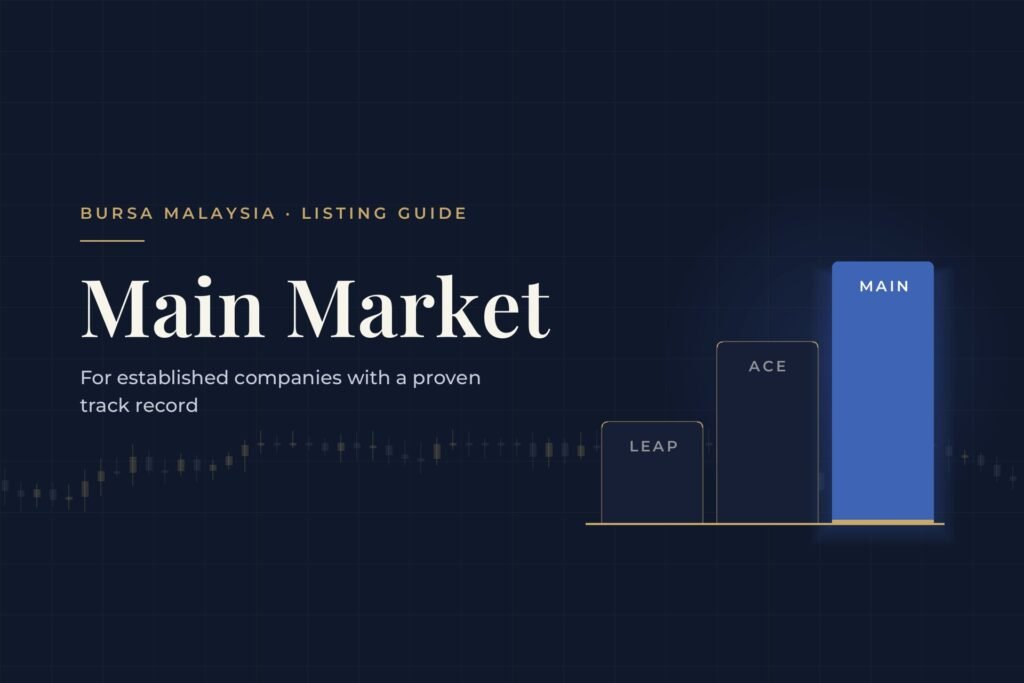
As Bursa Malaysia’s prime market, the Main Market is built for companies that already have a solid track record: strong financial results, well-defined operations and the resources to handle heavier regulatory, disclosure and governance obligations. To get in, a company must pass one of three entry tests (the Profit Test, the Market Capitalisation Test or the Infrastructure Project Corporation Test), and its listing must be approved by the Securities Commission Malaysia (“SC”).
Listing Requirements
A. Listing Factors
Before Aisyah’s advisers get to the numbers, there is a broader question: is her company ready to be a listed company?
Before checking whether a company meets the formal admission requirements, the SC looks at whether the company is suitable for listing on the Main Market overall. In general, the company should be able to show the following:
Identifiable core business
The company should own a majority of, and control the management of, a clear core business that is its main source of operating revenue or after-tax profit.
Good management
The company should be run by capable people with the right experience and qualifications. There should also be enough continuity in the management team.
For Aisyah, this means showing that her team has been stable and can run a listed company, not just a private one.
Responsible directors
The directors should understand their fiduciary duties (their legal duty to act in the company’s best interests) and be able to carry out their duties as directors of a public listed company.
Once listed, Aisyah and her fellow directors must act in the interests of all shareholders, not just the original owners.
Risk management and internal controls
The company should have proper internal controls and risk management systems that suit its business operations and growth plans.
Healthy financial position
The company should be in good financial health, including positive cash flow from its operations and enough working capital for at least 12 months after listing.
Aisyah’s steady profits help here, but her advisers will also check that the business actually brings in cash, not just profits on paper.
Commitment to compliance
The company should have enough systems, procedures, policies, controls and resources to keep complying with the applicable rules and regulations on an ongoing basis.
Business prospects
The company should have sustainable business prospects. Examples include operating in a growth industry, having an established brand or market presence, having a competitive edge and having a core business that is well placed to generate returns.
No unresolved conflicts of interest
Any conflicts of interest should be properly resolved before listing.
For example, if Aisyah also owns a separate company that supplies raw materials to her factory, this would need to be addressed before listing.
Good corporate governance
The company should have strong corporate governance policies and practices. Its founders, promoters, directors and management team should also have a good track record on corporate governance.
Public interest
Listing the company should not go against the public interest.
The company’s prospectus is the main disclosure document for the listing. It will set out relevant and adequate information on the company’s past performance and future prospects.
B. Admission Requirements
On top of the listing factors above, the company must meet the formal admission requirements for the Main Market. These are mainly found in the SC’s Equity Guidelines and Bursa Malaysia’s Main Market Listing Requirements.
Approving authority
Listing on the Main Market requires the SC’s approval. Under the Main Market Listing Requirements, the company must get approval from the SC, and any other relevant authorities, before its shares can be listed and traded on Bursa Malaysia.
Mode of listing
A company seeking to list on the Main Market must generally meet one of these three tests:
- Profit Test
This is the test Aisyah is most likely to use. Suppose her company made after-tax profits of RM12 million, RM14 million and RM18 million over its last three financial years. That adds up to RM44 million, with RM18 million in the latest year, so it would meet both thresholds.
The company must have made a total after-tax profit of at least RM30 million over its most recent three full financial years, and at least RM15 million in the most recent financial year, based on audited financial statements. The company (or the relevant company in its group) must also have been in the same core business for at least that three-year profit track record period.
- Market Capitalisation Test
The company’s total market value (market capitalisation) must be at least RM500 million on listing. This is worked out using the IPO price in the prospectus and the total number of shares in issue after the IPO. The company (or the company in its group that carries on the core business) must also have been incorporated and earning operating revenue for at least its most recent full financial year, based on audited financial statements.
- Infrastructure Project Corporation Test
This test applies where the company’s core business is an infrastructure project. The company, directly or through a subsidiary, must have the right to build and operate an infrastructure project in or outside Malaysia costing at least RM500 million. The concession or licence for the project must have been granted by a government or state agency, with at least 15 years left to run at the time of listing.
Core business
The company must have a clear core business that it majority-owns and manages. Its core business cannot be the holding of investments in other listed companies.
Management continuity and capability
If Aisyah is planning to hire a new chief financial officer before listing, timing matters, as explained below.
The company must have had substantially the same management team for at least its most recent three full financial years before applying to the SC. For a company listing under the Market Capitalisation Test or the Infrastructure Project Corporation Test that has been operating for less than three full financial years, this applies from when it started operations. The company must also show that its executive directors and senior management have played a significant role in running the business. Its chief financial officer (or person in an equivalent role) must have been appointed at least six months before the application to the SC.
Financial position and liquidity
The company must be in good financial health, with enough working capital for at least 12 months from the date of the prospectus. A company listing under the Profit Test must also have no accumulated losses in its latest audited financial statements. When assessing financial health, the SC will consider whether the company has had positive cash flow from its operations over its most recent three full financial years (or since it started operating, if shorter).
Public spread
Public spread refers to how widely the company’s shares are held by the public. Generally, at least 25% of the shares or units being listed must be held by at least 1,000 public shareholders, each holding at least 100 shares or units.
For Aisyah, this generally means at least 1,000 public investors will own part of her company.
Bursa Malaysia may accept a lower percentage if it is satisfied that this is enough for a liquid market (one where shares can be readily bought and sold).
Offering to the general public
The way the shares are offered should help the company build a broad shareholder base and meet the public spread requirement. As part of the IPO, the company must generally offer shares to the public through balloting (a random draw among applicants), subject to the minimum percentages set out in the SC’s Equity Guidelines.
Independent directors, audit committee and constitution
Aisyah’s board will probably need to change before listing.
At least two directors, or one-third of the board (whichever is higher), must be independent directors. On a board of five, for example, at least two must be independent. The company must also set up an audit committee made up mostly of independent directors, and include the relevant provisions of Chapter 7 of the Main Market Listing Requirements in its constitution.
Related party transactions and outstanding debts
If Aisyah has borrowed money from her company, for example, she would need to repay it before listing.
Any dealings before listing between the company (or its subsidiaries) and related parties must be on terms that are not unfavourable to the company. Before listing, interested persons must also fully settle all non-trade debts they owe the company or its subsidiaries, and all trade debts that are overdue beyond the normal credit period.
Moratorium on shares
A moratorium is a lock-up period during which certain shareholders cannot sell their shares. For listings under the Profit Test or Market Capitalisation Test, the shareholders concerned cannot sell, transfer or assign their shares for six months from the listing date.
If Aisyah is one of them, she should not expect to sell her own shares straight after listing.
Additional conditions apply to listings under the Infrastructure Project Corporation Test, especially where the project has not yet generated one full financial year of audited operating revenue.
Additional requirements for specific applicants
Extra requirements may apply depending on the company’s business. For example, a company involved in mineral or oil and gas exploration or extraction must meet specific requirements, including having enough working capital for at least 18 months from the date of the prospectus. Foreign companies may also face additional requirements on currency denomination, exchange control approvals and resident directors.
Bumiputera Equity Requirement (if applicable)
If this requirement applies to Aisyah’s company, she should plan for it early, as it affects how her shares are allocated at listing.
Where it applies, a Main Market company with mainly Malaysian-based operations must set aside 12.5% of its total shares after the IPO for Bumiputera investors at the point of listing. These investors must be approved or recognised by the Ministry of Investment, Trade and Industry, or by the Ministry of Finance for licensed financial institutions. In addition, where shares are offered to the Malaysian public by balloting, at least 50% of those shares must be made available to Bumiputera public investors. Companies should confirm how this requirement applies to them with the relevant authorities and their advisers, as it depends on the company’s business, status and listing structure.
Conclusion
For Aisyah, listing on the Main Market is not one test to pass but a series of requirements to prepare for. Her profits may already clear the Profit Test, but board changes, related party loans, management continuity and, where it applies, the Bumiputera allocation all take planning. Some cannot be fixed at the last minute, like appointing a chief financial officer at least six months before applying. Companies considering a Main Market listing should start preparing early and work with their advisers to confirm which requirements apply to them.

Have a question on a related matter? Reach out to our partner.
Get in touch